Consistent Effort

When I wrote my first novel, I did it through the consistency of writing every day. Participating in 2022’s National Novel Writing Month, I wrote daily for weeks straight, plowing through a novel that I’d been dreaming about writing for more than two years at that point. (And all of that after ten years of struggling to write any novel.)

The following spring I wrote another novel, again in a wave of consistency. And later that year, I wrote my third, finishing it during another NaNoWriMo rush.

Lately, I’ve been struggling with getting to the keyboard. It seems like all the “little things” in life keep popping up, stopping me before I start. But it’s only resistance, and it’s only winning because I let it, because I’m in an all-or-nothing mentality. If I can’t get my scheduled couple of hours, I might as well not start.

Consistency doesn’t mean I have to spend hours a day writing, though, it means I have to spend one, or thirty minutes, or fifteen. It’s not about hours per day. It’s about days showing up. If I had sat down for even five minutes a day, I’d have more words to show for the last few weeks than I do now.

Ideally, I’d hit a thousand words a day. On average, that amounts to about an hour, even less if I hit a good flow. (For the record, I hit my thousand word goal this morning in thirty-two minutes.) Like Bradbury said, “All I need is an hour, and I’m ahead of everyone.” Hardly a day goes by where I can’t squeeze in at least an hour of writing, even if it means setting the alarm a bit earlier.

A thousand words a day, consistently, is enough to write every story idea bouncing around my head, fifty of them by my last count, about half shorts and the other half novels. A thousand words a day gets them all done by my fiftieth birthday, a kind of fifty by fifty scenario.

On that birthday, I can look back with regret, or I can look back on the years of consistency that took my life to the next level. It’s as simple (but not easy) as that.


Heading photo by Aron Visuals on Unsplash

The Skull Speaks

I’ve played with this chattering skull for forty years.

Recently, I’ve been working on a story called (for now) “Put Another Nickel In” and I’ve got a few thousand words on the page so far. Today, the main character finally gave me his a name, Hunch, and I hit my word count goal. It’s a solid day’s work, considering the habit I’m trying to build of writing a thousand words per day, every day, following the example of this Ray Bradbury quote:

“I’m accustomed, you see, to getting up every morning, running to the typewriter, and in an hour I’ve created a world. I don’t have to wait for anyone. I don’t have to criticize anyone. It’s done. All I need is an hour, and I’m ahead of everyone. The rest of the day I can goof off. I’ve already done a thousand words this morning; so if I want to have a two or three-hour lunch, I can have it, because I’ve already beat everyone.”

Consistency over quantity. I’ve had bursts of it before, but never managed to keep it going for long. Hopefully this time is different.

At some point in the night, though, I realized that Hunch wasn’t alone. I don’t mean all the monsters he’s tasked with keeping in their enchanted sleep, but as far as a true companion. There was someone else in that chamber of horrors, if I would only listen. Like Hunch and his monsters, though, I went to sleep.

When I got back to the keyboard this morning, I started by cycling back through those first thousand words and trying harder to hear what the story was telling me. Just a few paragraphs in, I found that missing party: Jaw, a talking skull in the corner of the room.

I kept writing, going back through yesterday’s words and continuing on to new story, all while listening more closely, and hearing his voice. He had plenty to say.

In the end, I hit my thousand-word count for yet another day, found a new character, and learned more about the world I’m exploring.

I think that’s a fine definition of a successful day.


Bradbury quote taken from his essay “Shooting Haiku in a Barrel”, collected in Zen in the Art of Writing

A Flurry of Inspiration

After taking years to finally finish drafting my first book, the second came in a flurry of inspiration and flow. Coming into November, I was already well into it. Then, using the NaNoWriMo challenge as an added motivator, I finished it up even earlier than I’d hoped.

The first draft of book two is done now, coming in right around 77,000 words just like the first book. I already have in mind several scenes that need to be added to improve the manuscript, so I expect that word count to go up quite a bit. For now, though, I’m moving right on to book three.

Without an outline, my goal is to get to the end of the series before I go back for revisions. Only then can I rewrite with the true end in mind, foreshadowing and focusing each book along the way. With the way it’s going, I’m confident I’ll get the first book finished and ready for the world sometime in 2024!


Identity Leads to Action

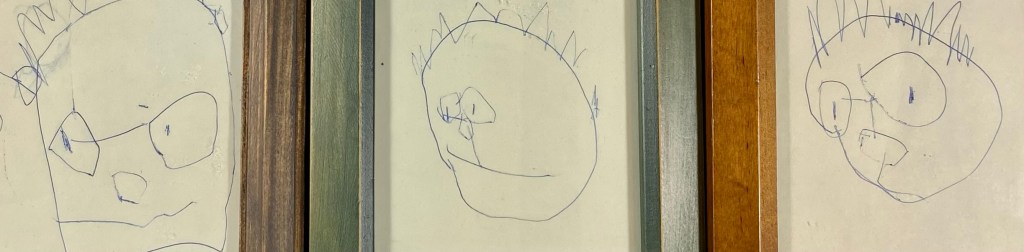
Self portraits (?) by a two-year-old Justin.

I’ve spent the last ten years or so wanting to be a writer.

For a small chunk of that, I’ve even written.

It feels like so much wasted time. Why didn’t I write more?

I’m realizing now that a big part of the problem was that, even though I wanted to be a writer, and even sometimes told people that’s what I was, I didn’t actually believe I was one. I simply saw myself as a stay-at-home dad. One that wrote sometimes, sure, but that was a secondary thing, no different than how I dabble in guitar, or paint now and then.

Obviously, there’s nothing wrong with being a stay-at-home parent. It was a huge blessing for our family to have a parent home. But, it wasn’t my identity. It was something I did for the benefit of my family, not something I felt called to do for myself.

Being a dad is an amazing and life-long role, of course, but the days of driving them to school and events, days of helping with homework and volunteering for field trips, that all has an expiration date. And who am I after that?

For me, I want to be a writer.

In fact, something I’ve recently noticed is this: no matter what other ideas or interests pop up, they all lead back to writing.

I play guitar because I like writing lyrics.

I paint because I like to illustrate my stories.

It all leads back to writing. Every time.

When I left my last corporate job to stay home with our new baby, I thought I’d take that chance to pursue my oldest childhood dream of becoming a writer. It was our second child, so I wasn’t naive about the free time I’d have or anything like that, but I was naive about being able to flip a mental switch and start a writing habit.

And so, for years and years, my writing habit was anything but. I’d write in bursts of motivation and inspiration, hit a roadblock, and stop for months. I told myself it was because the kids kept me busy, or the housework, or whatever excuse I could think of. Of course, none of those excuses stopped me from wasting hours surfing the web or watching television.

The problem wasn’t my family role. The problem was the way I saw myself. Instead of seeing me, the writer, I saw me, the guy that didn’t have the time for writing.

Lately, finally, I feel I’ve gotten past that roadblock.

For whatever other roles I have in life, when it comes to vocation, I’m a writer. Plain and simple.

That means I write.

Having that identity firmly in mind is the “ultimate form of intrinsic motivation”. Habit expert James Clear says:

“The ultimate form of intrinsic motivation is when a habit becomes part of your identity. It’s one thing to say ‘I’m the type of person who wants this.’ It’s something very different to say ‘I’m the type of person who is this.’”

Identity is key. In fact, In his book The Practice, Seth Godin talks a bit about child prodigies, adding this:

“It’s not important that the kids developed their musical skills when they were eleven. It’s important that they developed the habit of identity. When they looked in the mirror, they saw themselves as musicians, as artists, as people who had committed to a journey.”

It’s the old “fake it ‘til you make it” idea.

If you want to be a writer, be a writer.

If you want to be an artist, be an artist.

You have to see yourself as the you you want to be far before the rest of the world sees it. If you know who you are, you’ll soon find yourself doing the things to make that identity real to the rest of the world as well.

As for me, I am a writer.


James Clear quote from his book Atomic Habits

Seth Godin quote from his book The Practice

Trust the Subconscious

A while back I finished a story in a whirlwind of subconscious-driven words. It was a blast to write that way, something my logical side loves to suppress.

But suppress isn’t a strong enough word. My logical side crushes the voice of the subconscious, stomps on it until the story falls out flat and lifeless.

This time, however, I managed to just go with it. Fix it when it’s finished, I told myself.

But I didn’t fix anything.

When I started rewriting, I nearly cut a few of the more inspired chunks because they didn’t fit my market-influenced (and misguided) idea of good writing. But, I managed to stop myself. I left those portions. They somehow felt right, like they belonged there. Instead of cutting them, I sent the story off to my editor. I knew full well she’d tell me to make the cuts.

I should have put more trust that my subconscious knew what it was doing.

Not only did she not tell me to make the cuts, she told me to push even further with them. Those subconscious bits that logic tried to force out, those were some of her favorite parts.

For me as a writer, when I try to logic my way through a story, it inevitably falls flat. Hayao Miyazaki has said he removes logic from his approach to storytelling:

“Logic is using the front part of the brain, that’s all. But you can’t make a film with logic. Or if you look at it differently, everybody can make a film with logic. But my way is to not use logic.”

After this experience, I think it’s time to do the same. Logic has its place (though I’m starting to doubt even that), but the drafting stage isn’t it.

After feeling so many of my stories had come out flat recently, I think it’s time for a different approach.

Trust your subconscious. I’ll be trusting mine.


Miyazaki quote taken from his Midnight Eye interview

First Draft of a Dream

The first draft of a dream.

After years of thinking about writing this book, years of wanting to write it, I’ve finally pushed through the resistance to do it. It’s the first draft of a dream, an adventure of gunslingers and magic, carnival games, curses, and maybe a pinch of cannibalism, but I’ll blame that bit on my subconscious. I think it’s a fun story, and hopefully on the next draft I can make it a very good one, too.

In the mean time, I’ve published two short stories to Amazon to get the foundation laid for bigger things to come. Check them out here:

Thanks for reading!