“I’m just relaying what the voice in my head’s saying.” – Eminem (The Monster)
When the writing is going well, when my fingers are flying across the keyboard, I feel like I’m just a transcriber, maybe a translator. I feel like the stories are already there, tales of a world that I’m just discovering and dusting off to share with all of you. I’m more an explorer, an archeologist, than a writer.
I got to see this amazing art installation a few years ago and every time I get stuck with a writing project, the imagery explodes right back to mind. So many books, so many ideas, all caged up. (Or censored in other ways, as is the case of the tribute.) It feels the same way inside my brain sometimes. But those locks have a key.
So I go hunting for that key in books, movies, anything that feels inspiring, really. And when I get back to the keyboard: freedom.
As the new year approaches, I’m thinking a lot about this quote from Isaac Asimov on his writing schedule:
“I don’t have fixed hours, I don’t drive myself, it’s just when I’m not doing anything else, I’m writing, and I don’t like to do anything else.” – Isaac Asimov
We’re a few days into National Novel Writing Month, and while I won’t be “officially” participating due to their views on generative AI (covered here and here by authors who say it far better than I would), I can’t help but reminisce on past efforts.
It was during NaNo a few years ago that I finally finished the draft of my first novel. The following November, I finished book two, then used that momentum to carry me straight through book three. Something about that deadline of November, of knowing there are so many other authors out there pushing hard all month, really gives me a boost.
You don’t need NaNoWriMo to do any of this of course. It doesn’t even have to be November. It’s the consistency that matters, a whole month, any month, of writing with a clear deadline rushing at your from the end of the calendar. That’s the trick.
NaNoWriMo as an organization has since tried to backpedal and “clarify” their statement, but it all strikes me as insincere, motivated by money, not morals. Of course, plenty of writers will still be using the NaNoWriMo website to keep motivated, and if you’re one of them, I’d only recommend not posting any of your actual words, because it’s not a stretch to say they’ll be selling them to the highest AI bidder come December.
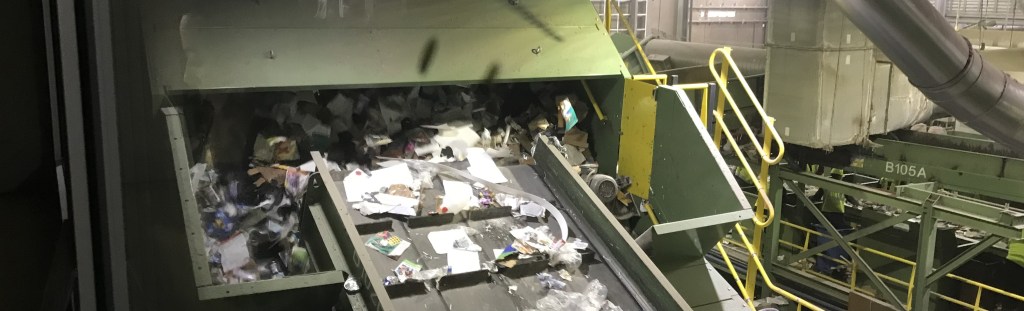
I went along with a school field trip to the recycling center a while back, and stumbling upon these pictures again has me thinking about recycling old ideas into brand new things.
Early on, as I took this fledgling idea of being a writer and tried to learn how to actually do it, I asked my wife for help thinking of character names. All those names are forgotten to time. Almost. Waters Cooper remains.
For some reason, Waters has stuck with me all this time. When I finally found the perfect place for him, it felt like he’d been patiently waiting for this story the whole time. His story.
Around the same time, I had a simple title idea come to mind (an homage to one of my favorite books): A Wizard of the West. I never did anything with it. I wasn’t good enough to write the story it deserved. (I’m still not.) Unused, the title went back from whence it came, waiting in my subconscious for its chance to see the light again. A few years ago it bubbled back up, and while it still isn’t a title I think I’ll use right now, the feeling it invokes has taken hold of my current writing.
Both of these ideas were, over time, forgotten, found again, and recycled into the current series I’m working on, the story of a wizard-in-the-making named Waters Cooper, and his world that, even if it isn’t quite “The West”, definitely branches off the same family tree.
“I am not an engineer, but an explorer. I discovered Earthsea.” – Ursula K. Le Guin
“Stories are found things, like fossils in the ground… Stories are relics, part of an undiscovered, pre-existing world.” – Stephen King
I wish I could write an outline and stick to it. I wish writing one didn’t kill the story for me. My process would be much smoother.
Instead, I have to go digging, searching, exploring, and discover the story somewhere in the unknown parts of my subconscious. The beauty, though, the joy I get from writing, is in that exploration. When the right words, the right worlds, emerge through my fingertips, it feels like magic.
From the foreword to Le Guin’s The Wind’s Twelve Quarters. I love the way she talks with such reverence about writing.
“The relation between short story and novel, inside the writer’s head, is interesting. ‘Semley’s Necklace,’ though a complete story in itself, was the germ of a novel. I had done with Semley when I finished it, but there was a minor character, a mere by-stander, who did not sink back obediently into obscurity when the story was done, but who kept nagging me. ‘Write my story,’ he said. ‘I’m Rocannon. I want to explore my world. . . .’ So I obeyed him. You really can’t argue with these people.
‘Winter’s King’ was another such germinal story, and so were ‘The Word of Unbinding’ and ‘The Rule of Names,’ though all of them gave me the place, rather than the person, for the novels to come. The last story in the book is not a germinal but an autumnal one. It came after the novel, a final gift, received with thanksgiving.”
In a 1947 essay titled “On the Writing of Speculative Fiction,” writer Robert A. Heinlein laid out his now-famous rules. I’ve tried to follow them in the past with varied success, struggling most with #2 and #5. I’m sharing them now as a reminder to myself more than anything. His rules (with an addition from Harlan Ellison that I learned watching Neil Gaiman) are these:
You must write
You must finish what you start
You must refrain from rewriting except to editorial order (…and then, only if you agree – Ellison)
You must put it on the market
You must keep it on the market until sold
I have a habit of overcomplicating things, of trying to go down too many paths at the same time and finding myself stuck for my confused effort. Instead, I’ll be simplifying things going into the last few months of the year.
“I’ve had a sign over my typewriter for twenty-five years now which reads ‘don’t think’. You must never think at the typewriter. You must feel.” – Ray Bradbury
When I wrote my first novel, I did it through the consistency of writing every day. Participating in 2022’s National Novel Writing Month, I wrote daily for weeks straight, plowing through a novel that I’d been dreaming about writing for more than two years at that point. (And all of that after ten years of struggling to write any novel.)
The following spring I wrote another novel, again in a wave of consistency. And later that year, I wrote my third, finishing it during another NaNoWriMo rush.
Lately, I’ve been struggling with getting to the keyboard. It seems like all the “little things” in life keep popping up, stopping me before I start. But it’s only resistance, and it’s only winning because I let it, because I’m in an all-or-nothing mentality. If I can’t get my scheduled couple of hours, I might as well not start.
Consistency doesn’t mean I have to spend hours a day writing, though, it means I have to spend one, or thirty minutes, or fifteen. It’s not about hours per day. It’s about days showing up. If I had sat down for even five minutes a day, I’d have more words to show for the last few weeks than I do now.
Ideally, I’d hit a thousand words a day. On average, that amounts to about an hour, even less if I hit a good flow. (For the record, I hit my thousand word goal this morning in thirty-two minutes.) Like Bradbury said, “All I need is an hour, and I’m ahead of everyone.” Hardly a day goes by where I can’t squeeze in at least an hour of writing, even if it means setting the alarm a bit earlier.
A thousand words a day, consistently, is enough to write every story idea bouncing around my head, fifty of them by my last count, about half shorts and the other half novels. A thousand words a day gets them all done by my fiftieth birthday, a kind of fifty by fifty scenario.
On that birthday, I can look back with regret, or I can look back on the years of consistency that took my life to the next level. It’s as simple (but not easy) as that.





 Justin Williams